



SUKIYAKI • TANKA
冬の夜 鍋の湯気立ち 君と食む すき焼きの香 明治の灯り
明
明治五年 • MEIJI 5

SEO • INTRO + EXCERPT — ONE TEXT
Excerpt (155 chars, for WordPress Excerpt + Meta Description):
Sukiyaki (Japanese Hot Pot with Beef & Vegetables) — a Meiji-era winter hot pot from 1872, sweet warishita, thin beef, winter vegetables and a raw egg dip.
Small Intro (425 chars):
Sukiyaki (Japanese Hot Pot with Beef & Vegetables) — a Meiji-era winter hot pot from 1872, sweet warishita, thin beef, winter vegetables and a raw egg dip. In the fifth year of Meiji, Japan tasted beef for the first time, and gyunabe became sukiyaki — one pot in the centre, everyone dipping. This article is the story around the recipe: Meiji history, the poem on the left, winter in Japan, washoku, and how to eat together.
Keywords: sukiyaki, Japanese hot pot, Meiji, winter, warishita, beef, Japan, washoku
SEO • INTRO + EXTRAIT — UN SEUL TEXTE
Extrait (149 caractères, pour Extrait WordPress + Meta Description) :
Sukiyaki (Pot-au-feu japonais au bœuf & légumes) — pot-au-feu d’hiver Meiji 1872, warishita sucré, bœuf fin, légumes d’hiver et œuf cru pour tremper.
Petite Intro :
Sukiyaki (Pot-au-feu japonais au bœuf & légumes) — pot-au-feu d’hiver Meiji 1872, warishita sucré, bœuf fin, légumes d’hiver et œuf cru pour tremper. En la cinquième année de Meiji, le Japon a goûté le bœuf pour la première fois, et le gyunabe est devenu sukiyaki — un pot au centre, tout le monde trempe. Cet article est l’histoire autour de la recette : histoire Meiji, poème à gauche, hiver au Japon, washoku, et comment manger ensemble.
Mots-clés : sukiyaki, pot-au-feu japonais, Meiji, hiver, warishita, bœuf, Japon, washoku
Old document • Meiji 5 • 1872 • Modern kitchen
Sukiyaki (Japanese Hot Pot with Beef & Vegetables)
A document from the year Japan first tasted beef, written for a modern kitchen. One pot, sweet warishita, thin beef, winter vegetables, and a raw egg to dip into. Hot, sweet, salty, silky — and gone in 30 minutes.
すき焼き • SUKIYAKI Meiji 5 — 24 January 1872, the Emperor eats beef for the first time. Tokyo opens to the world, and gyunabe becomes sukiyaki.
Document ancien • Meiji 5 • 1872 • Cuisine moderne
Sukiyaki (Pot-au-feu japonais au bœuf & légumes)
Un document de l’année où le Japon a goûté le bœuf pour la première fois, écrit pour une cuisine moderne. Un pot, un warishita sucré, du bœuf fin, des légumes d’hiver, et un œuf cru pour tremper. Chaud, sucré, salé, soyeux — et fini en 30 minutes.
すき焼き • SUKIYAKI Meiji 5 — 24 janvier 1872, l’Empereur mange du bœuf pour la première fois. Tokyo s’ouvre au monde, et le gyunabe devient sukiyaki.
Use EN / FR at the top. Written like an old document — washi paper, ink, seal — but with modern, certain measurements, timings and food safety. No Czech version is published.Utilisez EN / FR en haut. Écrit comme un document ancien — papier washi, encre, sceau — mais avec des mesures, des temps et une sécurité alimentaire modernes et certains. Aucune version tchèque n’est publiée.
Contents — an article, not a recipeSommaire — un article, pas une recette
Ingredients, steps, chef tips, allergens and nutrition live in the separate recipe. This article is the story around it — Japan, winter, the table.Ingrédients, étapes, conseils, allergènes et nutrition vivent dans la recette séparée. Cet article est l’histoire autour — le Japon, l’hiver, la table.
1. The DocumentLe DocumentMeiji 5, 1872
2. PoemPoèmeLeft side
3. HistoryHistoireGyunabe to sukiyaki
4. How to EatComment mangerDip in egg
5. Recipe CardFiche RecetteSeparate recipe →
6. Washoku & UmamiWashoku & UmamiFive tastes, five colours
7. Nabemono FamilyFamille NabemonoShabu, oden, chanko
8. Winter in JapanHiver au JaponYuki, kotatsu, nabe
9. The Table TogetherLa Table EnsembleItadakimasu
10. Sake, Tea & SweetsSaké, Thé & DouceursAfter the pot
Document • Meiji 5 • 24 January 1872
An old document, a modern kitchen
In the fifth year of Meiji, the Emperor tasted beef for the first time. The ports were open. The old ban on meat, kept for more than a thousand years, was lifting. In Yokohama and Tokyo, cooks began to make gyunabe — beef pot — sweet, to hide the unfamiliar smell of meat, and to make it approachable.
That is the year this recipe belongs to. Not a museum piece. A living dish. The large image behind this section is now the page background — static, so the page feels alive as you scroll. This Document section itself is borderless and backgroundless, so the image breathes through. We write it like an old document — paper, ink, seal — because that is where it was born. We cook it with modern certainty — exact grams, exact minutes, safe eggs, a clean pot — because that is how we cook now.
The rule of sukiyaki: Do not drown it. Warishita is shallow. You simmer, you dip, you eat, you add more. The pot never sits full. It is always becoming.
Document • Meiji 5 • 24 janvier 1872
Un document ancien, une cuisine moderne
En la cinquième année de Meiji, l’Empereur a goûté le bœuf pour la première fois. Les ports étaient ouverts. L’ancienne interdiction de la viande, gardée pendant plus de mille ans, se levait. À Yokohama et Tokyo, les cuisiniers ont commencé à faire du gyunabe — pot de bœuf — sucré, pour cacher l’odeur inconnue de la viande, et pour le rendre accessible.
C’est l’année à laquelle cette recette appartient. Pas une pièce de musée. Un plat vivant. La grande image derrière cette section est maintenant le fond de la page — fixe, pour que la page semble vivante quand vous faites défiler. Cette section Document elle-même est sans bordure et sans fond, pour que l’image respire à travers. Nous l’écrivons comme un document ancien — papier, encre, sceau — parce que c’est là qu’il est né. Nous le cuisinons avec une certitude moderne — grammes exacts, minutes exactes, œufs sûrs, pot propre — parce que c’est ainsi que nous cuisinons maintenant.
La règle du sukiyaki : Ne le noyez pas. Le warishita est peu profond. Vous mijotez, vous trempez, vous mangez, vous ajoutez. Le pot n’est jamais plein. Il est toujours en train de devenir.

The Poem • Left Side, Top to Bottom
The poem on the left side
Down the whole left side of this page, top to bottom, you are reading a poem. It is not decoration. It is the dish, in five lines — winter, steam, together, scent, light. It is written as a tanka, the old Japanese five-line form, in the spirit of Meiji.
Le Poème • Côté gauche, de haut en bas
Le poème sur le côté gauche
Tout le long du côté gauche de cette page, de haut en bas, vous lisez un poème. Ce n’est pas une décoration. C’est le plat, en cinq lignes — hiver, vapeur, ensemble, parfum, lumière. Il est écrit comme un tanka, l’ancienne forme japonaise en cinq lignes, dans l’esprit de Meiji.
すき焼き • TANKA • MEIJI 5
冬の夜
鍋の湯気立ち
君と食む
すき焼きの香
明治の灯り
Fuyu no yoru
Nabe no yuge tachi
Kimi to hamu
Sukiyaki no kaori
Meiji no akari
すき焼き
Translation — EnglishTraduction — Français
“On a winter night,
steam rises from the pot,
I eat with you,
the scent of sukiyaki,
the light of Meiji.”
« Par une nuit d’hiver,
la vapeur monte du pot,
je mange avec toi,
le parfum du sukiyaki,
la lumière de Meiji. »
| LineLigne | MeansSignifie |
|---|---|
| 冬の夜 Fuyu no yoru | Winter night — sukiyaki is a winter dish, cold outside, warm inside.Nuit d’hiver — le sukiyaki est un plat d’hiver, froid dehors, chaud dedans. |
| 鍋の湯気立ち Nabe no yuge tachi | Steam rises from the pot — the pot is in the centre, always moving.La vapeur monte du pot — le pot est au centre, toujours en mouvement. |
| 君と食む Kimi to hamu | I eat with you — sukiyaki is never eaten alone, it is shared.Je mange avec toi — le sukiyaki ne se mange jamais seul, il se partage. |
| すき焼きの香 Sukiyaki no kaori | The scent of sukiyaki — sweet warishita, soy, mirin, beef.Le parfum du sukiyaki — warishita sucré, soja, mirin, bœuf. |
| 明治の灯り Meiji no akari | The light of Meiji — 1872, a new era, a new table, a new light.La lumière de Meiji — 1872, une ère nouvelle, une table nouvelle, une lumière nouvelle. |
How to read it: top to bottom, right to left, like an old document. The left side of the page is the poem, the rest of the page is the cooking. Same story, two ways.Comment le lire : de haut en bas, de droite à gauche, comme un document ancien. Le côté gauche de la page est le poème, le reste de la page est la cuisine. Même histoire, deux façons.
History • Source: Wikipedia, Sukiyaki + JETRO
From gyunabe to sukiyaki
Sukiyaki is a one-pot dish, nabemono, developed during the Meiji era (1868–1912). Before that, beef was largely avoided for over a millennium, for Buddhist and Shinto reasons. When Japan opened its ports, meat-eating became a symbol of the new age — modern, Western, strong.
Histoire • Source : Wikipedia, Sukiyaki + JETRO
Du gyunabe au sukiyaki
Le sukiyaki est un plat en un pot, nabemono, développé pendant l’ère Meiji (1868–1912). Avant cela, le bœuf était largement évité depuis plus d’un millénaire, pour des raisons bouddhistes et shintoïstes. Quand le Japon a ouvert ses ports, manger de la viande est devenu un symbole du nouvel âge — moderne, occidental, fort.
~1200 – 1867 • The long banBeef avoided for over 1,000 years. Farmers, legend says, would grill meat on a suki — a spade — over fire, quietly. The name suki-yaki, spade-grilled, may come from there.Bœuf évité pendant plus de 1 000 ans. Les fermiers, dit la légende, grillaient la viande sur un suki — une bêche — au feu, discrètement. Le nom suki-yaki, grillé à la bêche, viendrait de là.
1868 – 1912 • Meiji era opensMeiji Restoration. Ports open. Western influence. Meat dishes go from occasional to everyday. Gyunabe, beef pot, becomes fashionable in Tokyo and Yokohama.Restauration Meiji. Ports ouverts. Influence occidentale. Les plats de viande passent d’occasionnels à quotidiens. Le gyunabe, pot de bœuf, devient à la mode à Tokyo et Yokohama.
24 Jan 1872 • Meiji 5, Emperor eats beefThe Emperor of Japan eats beef for the first time. A signal to the whole country: meat is now modern, not taboo.L’Empereur du Japon mange du bœuf pour la première fois. Un signal pour tout le pays : la viande est désormais moderne, pas taboue.
1870s – 1900s • Gyunabe becomes sukiyakiThe sweet broth — warishita — masks the unfamiliar scent of meat and makes it approachable. After the Great Kanto Earthquake, the Tokyo beef pot is renamed sukiyaki, a name taken from Kansai.Le bouillon sucré — warishita — masque l’odeur inconnue de la viande et la rend accessible. Après le grand tremblement de terre du Kanto, le pot de bœuf de Tokyo est renommé sukiyaki, un nom venu du Kansai.
1960s • Celebration dishBy the 1960s, sukiyaki is the go-to celebratory dish for Japanese families — New Year, birthdays, cold months, everyone around one pot.Dès les années 1960, le sukiyaki est le plat de fête des familles japonaises — Nouvel An, anniversaires, mois froids, tout le monde autour d’un pot.
Today • Winter, everywhereSukiyaki is especially popular in cold weather and at celebrations. One pot, in the centre, everyone dipping. The same idea as Korean BBQ, in a Japanese key.Le sukiyaki est surtout populaire par temps froid et pour les fêtes. Un pot, au centre, tout le monde trempe. La même idée que le BBQ coréen, en clé japonaise.
Why sweet warishita?Pourquoi un warishita sucré ? From the beginning, the bold sweetness had a dual purpose: it masked the unfamiliar scent of meat, and it made the new flavour approachable for a nation that had avoided beef for a millennium. — JETRODès le début, la douceur audacieuse avait un double but : masquer l’odeur inconnue de la viande, et rendre la nouvelle saveur accessible à une nation qui avait évité le bœuf pendant un millénaire. — JETRO
How to eat • The ritual
Dip, eat, add, repeat
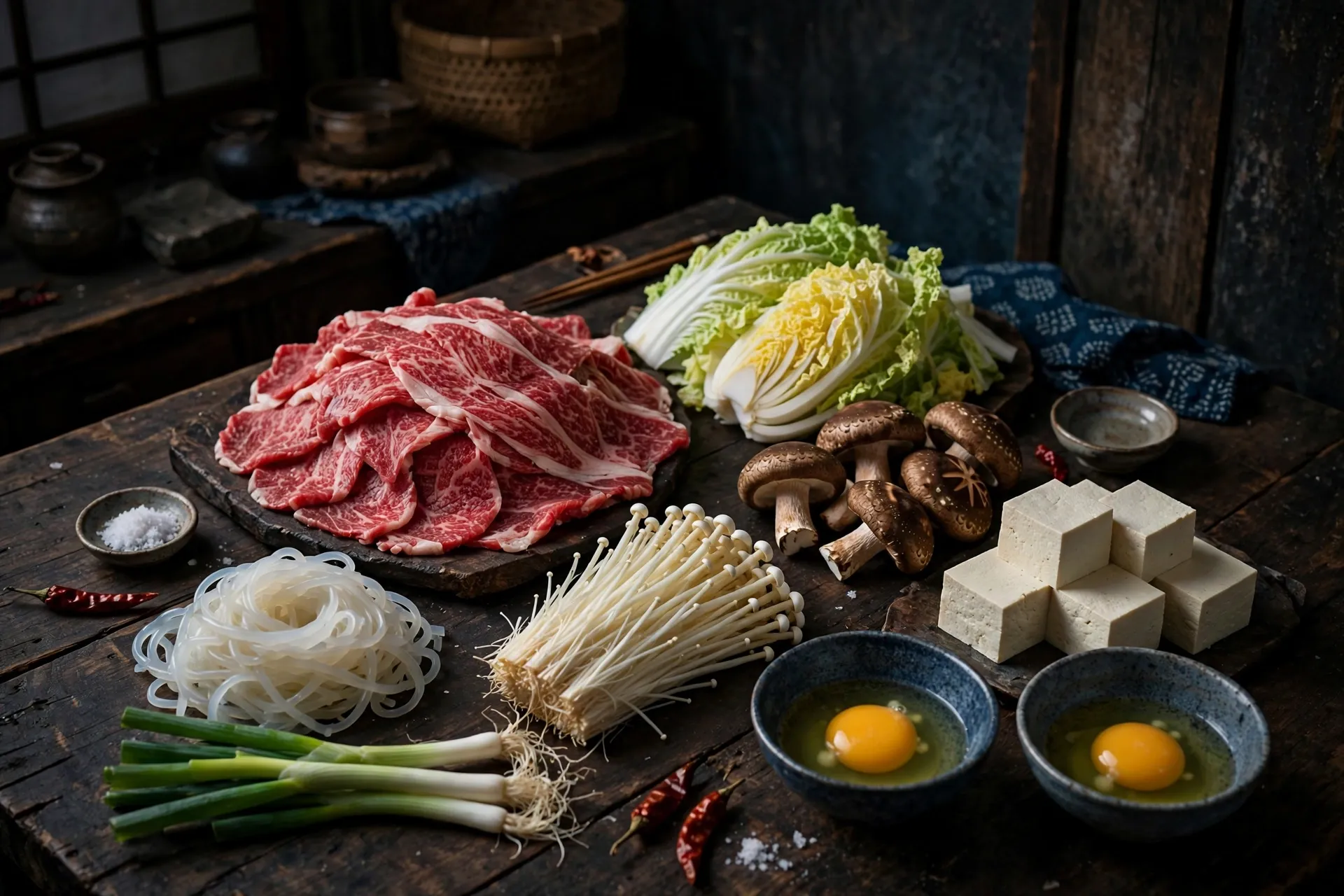
Sukiyaki is not served plated. It is cooked at the table, in front of you, in small waves. You take a slice of beef, still pink, dip it in raw egg, eat. You take a mushroom, a piece of tofu, a leaf of cabbage, dip, eat. Then you add more. The pot is never finished, until the udon at the end.
Comment manger • Le rituel
Trempez, mangez, ajoutez, recommencez
Le sukiyaki ne se sert pas dressé. Il se cuisine à table, devant vous, par petites vagues. Vous prenez une tranche de bœuf, encore rosée, vous la trempez dans l’œuf cru, vous mangez. Vous prenez un champignon, un morceau de tofu, une feuille de chou, vous trempez, vous mangez. Puis vous ajoutez. Le pot n’est jamais fini, jusqu’aux udon à la fin.
Sear in suetSaisissez dans le suif
Melt suet in the pot, sear one slice of beef to perfume the pot.Faites fondre le suif dans le pot, saisissez une tranche de bœuf pour parfumer le pot.
Add warishita, shallowAjoutez le warishita, peu profond
Just enough to simmer, not to drown. The pot should hiss, not boil.Juste assez pour mijoter, pas pour noyer. Le pot doit grésiller, pas bouillir.
Dip in raw eggTrempez dans l’œuf cru
Each person has one egg, cracked in a small bowl. Dip hot beef, it cools and turns silky. Use very fresh, pasteurised eggs if you prefer.Chacun a un œuf, cassé dans un petit bol. Trempez le bœuf chaud, il refroidit et devient soyeux. Utilisez des œufs très frais, pasteurisés si vous préférez.
Finish with udonFinissez aux udon
When the pot is almost empty, add udon. It soaks up every last drop. That is shime, the closing.Quand le pot est presque vide, ajoutez les udon. Ils absorbent la dernière goutte. C’est le shime, la clôture.
Recipe Card • WordPress
Recipe Card — live in WordPressFiche Recette — en direct dans WordPress
This article does NOT contain ingredients, steps, tips, allergens or nutrition — they live in the separate recipe. When you create this recipe in online-chef, replace REPLACE with its recipeId. In WordPress it will render the full card automatically.Cet article ne contient PAS d’ingrédients, étapes, conseils, allergènes ou nutrition — ils vivent dans la recette séparée. Quand vous créerez cette recette dans online-chef, remplacez REPLACE par son recipeId. Dans WordPress, elle affichera la fiche complète automatiquement.

Sukiyaki (Japanese Hot Pot with Beef & Vegetables)
⏱ 65 min
Sukiyaki (Japanese Hot Pot with Beef & Vegetables) · a Meiji-era winter hot pot from 1872, sweet warishita, thin beef, winter vegetables and a raw egg dip.
View recipeSukiyaki — Recipe ID: replace after publishing in online-chef
WordPress block: wp:ocr/single • layout feature • Full ingredients and steps are also below, so the article works even without WordPress.Bloc WordPress : wp:ocr/single • layout feature • Les ingrédients et étapes complets sont aussi ci-dessous, pour que l’article fonctionne même sans WordPress.
Japan & Food • Washoku
Washoku — food as harmony, not just hunger
In 2013, UNESCO added washoku, traditional Japanese food culture, to its Intangible Cultural Heritage list. Not for one dish, but for an idea: food should respect nature, seasons, balance, and the people you eat with.
Sukiyaki is washoku in a pot. It is seasonal — napa cabbage, mushrooms, negi in winter. It is balanced — five tastes in one warishita: sweet, salty, umami, a little bitter from greens, a little sour from egg. It is beautiful — five colours on the table: white tofu, green shungiku, brown shiitake, red beef, black pot.
Japon & Nourriture • Washoku
Washoku — la nourriture comme harmonie, pas seulement faim
En 2013, l’UNESCO a inscrit le washoku, la culture alimentaire traditionnelle japonaise, sur la liste du patrimoine culturel immatériel. Pas pour un plat, mais pour une idée : la nourriture doit respecter la nature, les saisons, l’équilibre, et les gens avec qui vous mangez.
Le sukiyaki est du washoku dans un pot. Il est saisonnier — chou napa, champignons, negi en hiver. Il est équilibré — cinq goûts dans un warishita : sucré, salé, umami, un peu amer des verts, un peu acide de l’œuf. Il est beau — cinq couleurs sur la table : tofu blanc, shungiku vert, shiitake brun, bœuf rouge, pot noir.
Gomi — Five TastesGomi — Cinq Goûts
Sweet, salty, sour, bitter, umami. Umami, the fifth, was named in Japan in 1908 — dashi, soy, mushrooms. Sukiyaki is built on it.Sucré, salé, acide, amer, umami. Umami, le cinquième, a été nommé au Japon en 1908 — dashi, soja, champignons. Le sukiyaki est construit dessus.
Goshoku — Five ColoursGoshoku — Cinq Couleurs
White, black, red, green, yellow. A Japanese meal should show them all. Look at a sukiyaki table — it does, without trying.Blanc, noir, rouge, vert, jaune. Un repas japonais doit les montrer toutes. Regardez une table de sukiyaki — elle le fait, sans essayer.
Shun — SeasonShun — Saison
Eat what is at its peak, now. Winter is the shun of sukiyaki — cabbage sweet after frost, mushrooms deep, beef rich.Mangez ce qui est à son apogée, maintenant. L’hiver est le shun du sukiyaki — chou doux après le gel, champignons profonds, bœuf riche.
Japan & Food • The Pot Family
Nabemono — one pot, many families
Nabemono means “things in a pot”. In Japan, winter is nabe season. Every region, every family has its own. Sukiyaki is the sweet one, the celebratory one, the one with beef and egg.
Japon & Nourriture • La Famille du Pot
Nabemono — un pot, plusieurs familles
Nabemono signifie « choses dans un pot ». Au Japon, l’hiver est la saison du nabe. Chaque région, chaque famille a le sien. Le sukiyaki est le sucré, le festif, celui au bœuf et à l’œuf.
| PotPot | BrothBouillon | ForPour |
|---|---|---|
| Sukiyaki すき焼き | Sweet warishita, shallowWarishita sucré, peu profond | Celebration, winter, beefFête, hiver, bœuf |
| Shabu-shabu しゃぶしゃぶ | Light dashi, swish-swishDashi léger, swish-swish | Delicate, thin meat, quickDélicat, viande fine, rapide |
| Chanko-nabe ちゃんこ鍋 | Rich chicken / misoPoulet riche / miso | Sumo wrestlers, big tablesLutteurs sumo, grandes tables |
| Oden おでん | Clear dashi, slow simmerDashi clair, mijotage lent | Street stalls, cold nightsStands de rue, nuits froides |
| Yose-nabe 寄せ鍋 | Soy-dashi, everythingSoja-dashi, tout | Use what you have, familyAvec ce qu’on a, famille |
The rule is the same for all: one pot in the centre, everyone cooks, everyone eats. The pot is not service, it is conversation.La règle est la même pour tous : un pot au centre, tout le monde cuisine, tout le monde mange. Le pot n’est pas un service, c’est une conversation.

Japan & Food • Winter
Winter in Japan — yuki, kotatsu, nabe
Winter in Japan is yuki, snow, kotatsu, the low heated table with a blanket, and nabe, the pot. You come in from the cold, you sit low, legs under the blanket, and the pot is already steaming.
In the north, Hokkaido, snow is metres deep. In Kyoto, it is quiet, temples in snow. In Tokyo, it is bright, dry, and the nabe shops glow. Everywhere, winter food is about warmth from inside — hot pot, oden from a cart, sweet potato from a stone oven, amazake, warm sake.
Japon & Nourriture • Hiver
L’hiver au Japon — yuki, kotatsu, nabe
L’hiver au Japon, c’est yuki, la neige, kotatsu, la table basse chauffée avec une couverture, et nabe, le pot. Vous rentrez du froid, vous vous asseyez bas, jambes sous la couverture, et le pot fume déjà.
Au nord, Hokkaido, la neige fait des mètres. À Kyoto, c’est calme, temples sous la neige. À Tokyo, c’est lumineux, sec, et les boutiques de nabe brillent. Partout, la nourriture d’hiver est la chaleur de l’intérieur — pot chaud, oden d’un chariot, patate douce du four de pierre, amazake, saké chaud.
New Year — OsechiNouvel An — Osechi
Sukiyaki is a New Year dish. Families gather, the pot is the centre, the year starts with steam, not with a speech.Le sukiyaki est un plat du Nouvel An. Les familles se rassemblent, le pot est le centre, l’année commence avec de la vapeur, pas avec un discours.
Onsen after nabeOnsen après nabe
Hot spring, then hot pot, then futon. That is the perfect winter day in Japan — heat, outside and inside.Source chaude, puis pot chaud, puis futon. C’est la journée d’hiver parfaite au Japon — chaleur, dehors et dedans.

Japan & Food • The Table
Itadakimasu — I receive, with thanks
Before eating, Japanese say itadakimasu — “I humbly receive”. After, gochisousama deshita — “thank you for the feast”. It is not a prayer, it is gratitude — to the cook, to the farmer, to the animal, to the season.
At a sukiyaki table, manners are simple: do not stab with chopsticks, do not pass food chopstick-to-chopstick, do not hover. Take, dip, eat, add. Let the oldest take first. Let the pot decide the pace.
Japon & Nourriture • La Table
Itadakimasu — Je reçois, avec merci
Avant de manger, les Japonais disent itadakimasu — « je reçois humblement ». Après, gochisousama deshita — « merci pour le festin ». Ce n’est pas une prière, c’est de la gratitude — envers le cuisinier, le fermier, l’animal, la saison.
À une table de sukiyaki, les manières sont simples : ne piquez pas avec les baguettes, ne passez pas la nourriture de baguettes à baguettes, ne survolez pas. Prenez, trempez, mangez, ajoutez. Laissez le plus âgé prendre d’abord. Laissez le pot décider du rythme.
The table is the recipeLa table est la recette In Japan, the pot is not just cooking. It is how a family stays close in winter — one heat, one pot, many hands.Au Japon, le pot n’est pas seulement de la cuisine. C’est la façon dont une famille reste proche en hiver — une chaleur, un pot, plusieurs mains.

Japan & Food • After the Pot
Sake, tea, and a sweet ending
After sukiyaki, Japan does not rush to dessert. It pauses. Hot sake, or barley tea, to clean the palate. Then a small sweet — wagashi, a bean-paste flower, a yuzu jelly, a slice of castella. Small, seasonal, beautiful. The meal ends like the poem — quietly, with light.
What to drink: Dry sake, hot or cold, with the pot. Or hot barley tea if you want no alcohol. Or a light lager, cold, to cut the sweetness.
What to eat after: Yuzu sorbet, matcha ice cream, or wagashi with matcha. Not a big cake — a small, perfect bite.
Japon & Nourriture • Après le Pot
Saké, thé, et une fin sucrée
Après le sukiyaki, le Japon ne se précipite pas vers le dessert. Il fait une pause. Saké chaud, ou thé d’orge, pour nettoyer le palais. Puis une petite douceur — wagashi, une fleur de pâte de haricot, une gelée de yuzu, une tranche de castella. Petite, saisonnière, belle. Le repas se termine comme le poème — doucement, avec de la lumière.
Que boire : Saké sec, chaud ou froid, avec le pot. Ou thé d’orge chaud si vous ne voulez pas d’alcool. Ou une lager légère, froide, pour couper la douceur.
Que manger après : Sorbet yuzu, glace matcha, ou wagashi au matcha. Pas un gros gâteau — une petite bouchée parfaite.
Saké
Dry, clean, served warm in winter. The Meiji drink — new, modern, Western and Japanese at once.Sec, propre, servi chaud en hiver. La boisson Meiji — nouvelle, moderne, occidentale et japonaise à la fois.
Matcha
Bitter, green, whisked. It resets the mouth after sweet warishita, and slows the evening down.Amer, vert, fouetté. Il réinitialise la bouche après le warishita sucré, et ralentit la soirée.
Wagashi
Seasonal sweets — sakura in spring, yuzu in winter. Eaten with the eyes first, then with tea.Douceurs saisonnières — sakura au printemps, yuzu en hiver. Mangées avec les yeux d’abord, puis avec le thé.
The recipe lives separatelyLa recette vit séparément All ingredients, steps, chef tips, allergens and nutrition are in the separate recipe card above — click it to cook. This article is for reading, dreaming, and understanding Japan.Tous les ingrédients, étapes, conseils, allergènes et nutrition sont dans la fiche recette séparée ci-dessus — cliquez dessus pour cuisiner. Cet article est pour lire, rêver, et comprendre le Japon.
