



S • P • Q • R
SENATUS POPULUSQUE ROMANUS — THE SENATE AND PEOPLE OF ROME SENATUS POPULUSQUE ROMANUS — LE SÉNAT ET LE PEUPLE DE ROME
SENATUS POPULUSQUE ROMANUS — THE SENATE AND PEOPLE OF ROME SENATUS POPULUSQUE ROMANUS — LE SÉNAT ET LE PEUPLE DE ROME
Tabula Culinaris • Historia Panis
Tabula Culinaris • Historia Panis

Chronicle of the Roman Hearth
Chronique du Foyer Romain
PITA Panis Focacius — Hearth Bread of Ancient Rome
PITA Panis Focacius — Pain du Foyer de la Rome Antique
Long before Rome raised its marble columns, humanity baked flat rounds of wild grain on sun-baked stones and glowing embers. From Natufian hearths in the Levant to Roman panis focacius, flatbread was torn, dipped, and shared across every table of the Mediterranean. In ancient Rome, grain was not an accompaniment—it supplied roughly sixty to seventy percent of daily calories, and the hearth was the sacred centre of the household.
Rome did not invent pita. Legions and merchants encountered leavened and unleavened pocket breads across the eastern provinces—in Syria, Judea, and Egypt—and carried the craft home to hot baking stones and tiles. There, Rome made it its own with cold-pressed olive oil, wild rosemary, and coarse sea salt. From focus, the Latin word for hearth, came focaccia; centuries later, topped with tomatoes and cheese in Naples, focaccia became pizza. One fire, three names.
Bien avant que Rome n’érige ses colonnes de marbre, l’humanité cuisait des galettes de céréales sauvages sur des pierres brûlantes et sous la braise. Des foyers natoufiens du Levant au panis focacius romain, le pain plat était déchiré, trempé et partagé à toutes les tables de la Méditerranée. Dans la Rome antique, les céréales n’étaient pas un simple accompagnement : elles fournissaient environ soixante à soixante-dix pour cent des calories quotidiennes, et le foyer demeurait le cœur sacré de la maison.
Rome n’a pas inventé la pita. Légions et marchands ont découvert ces pains plats à poche dans les provinces orientales — en Syrie, en Judée et en Égypte — avant d’en rapporter le savoir-faire sur leurs pierres et tuiles brûlantes. Rome se l’est approprié en l’arrosant d’huile d’olive, de romarin sauvage et de gros sel marin. De focus, le foyer en latin, est née la focaccia ; des siècles plus tard, garnie à Naples de tomates et de fromage, la focaccia est devenue pizza. Un seul feu, trois noms.
Fasti • Chronology
Fasti • Chronologie
Oldest flatbread (Shubayqa 1)Plus ancien pain plat (Shubayqa 1)
14,500 yrs
Guild of bakers in RomeCorporation des boulangers
171 BC
Vesuvius buries PompeiiLe Vésuve ensevelit Pompéi
AD 79
Public bakeries in RomeBoulangeries publiques à Rome
254
Via Panis • From Wild Grain to Imperial Rome
Via Panis • Des Grains Sauvages à la Rome Impériale
12,500 BCNatufian, JordanNatoufien, Jordanie
2500 BCMesopotamiaMésopotamie
800 BCGreeks & EtruscansGrecs & Étrusques
171 BCBakers in RomeBoulangers à Rome
AD 79PompeiiPompéi
AD 300254 bakeries254 boulangeries

CAPUT I • CHAPTER I
Ignis — The Fire
Ignis — Le Feu
Before the domed brick oven, there was the open hearth. A disc of dough slapped onto scorching stone or buried beneath glowing ash puffs within seconds. That is pita; that is Roman panis focacius. Its signature pocket is not a baker’s trick—it is pure physics. Intense radiant heat turns trapped moisture into steam, inflating the dough before the crust sets. If the fire is right, the bread breathes.
In 2018, archaeologists excavating a 14,500-year-old Natufian hunter-gatherer fireplace at Shubayqa 1 in northeastern Jordan uncovered charred crumbs of flatbread made from wild einkorn wheat, barley, and club-rush tubers—predating settled agriculture by four millennia. Bread is older than the plough.
Avant le four voûté en briques, il y avait l’âtre ouvert. Un disque de pâte plaqué sur une pierre brûlante ou glissé sous la cendre ardente gonfle en quelques secondes. C’est la pita ; c’est le panis focacius romain. Sa poche caractéristique n’est pas une ruse de boulanger, mais de la physique pure : une chaleur vive transforme l’eau de la pâte en vapeur avant que la croûte ne fige. Si le feu est juste, le pain respire.
En 2018, des archéologues fouillant un foyer natoufien vieux de 14 500 ans à Shubayqa 1, dans le nord-est de la Jordanie, ont mis au jour des miettes carbonisées de pain plat élaboré à partir d’engrain sauvage, d’orge et de tubercules de scirpe — quatre millénaires avant l’invention de l’agriculture. Le pain est plus vieux que la charrue.
CAPUT II • CHAPTER II
Farina — Flour & Life
Farina — Farine & Vie
By 2500 BC across Mesopotamia, Syria, and Egypt, flatbread baked on clay griddles and tandoor-style ovens was the staff of daily life. Linguists trace the word pita through Byzantine Greek píta (“bread, cake, pie”) to ancient Greek pítta or pēktós (“solidified, curdled”), which entered Latin as picta—the direct etymological ancestor of modern pizza.
In early Rome, families ate porridge (puls) made from emmer wheat (far) before leavened baking took hold. Later, Roman millers ground soft bread wheat (triticum), durum, and barley in hourglass-shaped volcanic stone mills turned by donkeys or enslaved labourers.
Dès 2500 av. J.-C., en Mésopotamie, en Syrie et en Égypte, le pain plat cuit sur des plaques d’argile ou dans des fours cylindriques constituait la base de l’alimentation. Les linguistes font remonter le mot pita au grec byzantin píta (« pain, gâteau, tourte »), issu du grec ancien pítta ou pēktós (« figé, solidifié »), passé en latin sous la forme picta — ancêtre direct du mot pizza.
Dans la Rome primitive, on consommait surtout une bouillie d’amidonnier (puls) avant que le pain levé ne s’impose. Plus tard, les meuniers romains broyèrent blé tendre (triticum), blé dur et orge dans des moulins en pierre volcanique en forme de sablier, actionnés par des ânes ou des esclaves.


INSCRIPTIO • EPIGRAPHE
EX IGNE PANIS,
EX FARINA VITA,
IN FOCO ROMA
PANEM SUUM PARIT.
EX FARINA VITA,
IN FOCO ROMA
PANEM SUUM PARIT.
Translation & Commentary
“From fire, bread; from flour, life; at the hearth, Rome brings forth its own bread.”
Rome adopted eastern flatbreads and bound them to the Roman hearth (focus). As the poet Juvenal famously observed, the Roman populace demanded two things above all: panem et circenses—bread and circuses.
“From fire, bread; from flour, life; at the hearth, Rome brings forth its own bread.”
Rome adopted eastern flatbreads and bound them to the Roman hearth (focus). As the poet Juvenal famously observed, the Roman populace demanded two things above all: panem et circenses—bread and circuses.
Traduction & Commentaire
« Du feu naît le pain, de la farine la vie ; dans son foyer, Rome enfante son propre pain. »
Rome a adopté les pains plats d’Orient pour les unir au foyer romain (focus). Comme l’écrivait le poète Juvénal, le peuple réclamait avant tout panem et circenses — du pain et des jeux.
« Du feu naît le pain, de la farine la vie ; dans son foyer, Rome enfante son propre pain. »
Rome a adopté les pains plats d’Orient pour les unir au foyer romain (focus). Comme l’écrivait le poète Juvénal, le peuple réclamait avant tout panem et circenses — du pain et des jeux.

CAPUT III • CHAPTER III
Pistor — The Baker
Pistor — Le Boulanger
In Latin, a baker was a pistor—literally “one who pounds,” from the verb pinso (to crush grain in a mortar). Pliny the Elder records in his Natural History (Book XVIII) that Rome had no professional bakers until the Third Macedonian War against King Perseus around 171 BC, more than 580 years after the City’s founding; until then, baking was women’s domestic work.
Once established, the collegium pistorum became a vital civic institution. By the fourth century AD, regionary catalogues listed 254 commercial bakeries (pistrina) across Rome’s fourteen districts, turning state grain into daily rations for citizens.
En latin, le boulanger se nommait pistor — littéralement « celui qui pile », du verbe pinso (broyer le grain au mortier). Pline l’Ancien rapporte dans son Histoire naturelle (Livre XVIII) qu’il n’y eut aucun boulanger de métier à Rome avant la guerre contre le roi Persée de Macédoine, vers 171 av. J.-C., plus de 580 ans après la fondation de la Ville ; jusque-là, le pain était pétri à la maison par les femmes.
Une fois instituée, la corporation des boulangers (collegium pistorum) devint un pilier civique. Au IVe siècle apr. J.-C., les catalogues régionaux recensaient 254 boulangeries publiques (pistrina) réparties dans les quatorze quartiers de Rome.
CAPUT IV • CHAPTER IV
Focus — The Hearth
Focus — Le Foyer
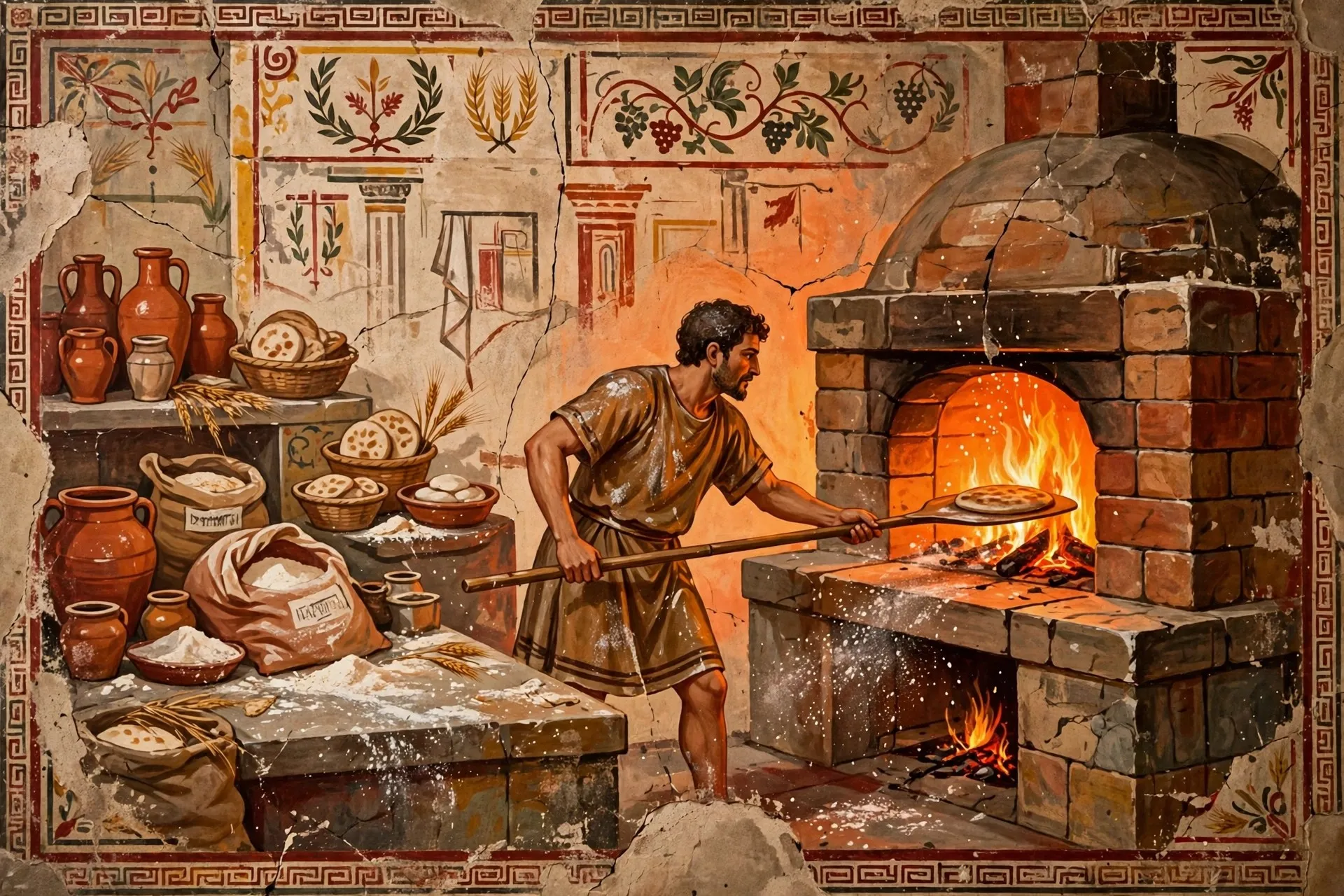
Focus meant the domestic fireplace, sacred to Vesta and the household gods. Panis focacius was hearth bread—baked directly on hot floor tiles or under an inverted earthenware dome (testum) heaped with glowing coals. Because it met fierce bottom heat without a tall loaf pan, it stayed flat, blistered, and hollow inside.
Roman writers distinguished loaves by flour and method: snowy panis siligineus from finest winter wheat for patricians; coarse bran-rich panis plebeius for workers; panis militaris, twice-baked hardtack for legions on the march; and panis focacius, brushed with olive oil and herbs—the direct ancestor of Italian focaccia.
Focus désignait l’âtre domestique, consacré à Vesta et aux dieux du foyer. Le panis focacius était le pain des cendres : cuit directement sur les dalles brûlantes ou sous une cloche en terre cuite (testum) recouverte de braises. Saisi par une chaleur intense par-dessous, il restait plat, cloquait et se creusait d’une poche.
Les auteurs romains distinguaient chaque pain selon sa farine et sa cuisson : le blanc panis siligineus de fleur de froment pour les patriciens ; le panis plebeius complet et sombre pour le peuple ; le panis militaris, biscuit sec des légions en marche ; et le panis focacius, badigeonné d’huile d’olive et d’herbes — ancêtre direct de la focaccia.
CAPUT V • CHAPTER V
Annona — Grain is Empire
Annona — Le Grain est Empire
At its height, imperial Rome housed nearly a million inhabitants—far more than Latium’s fields could feed. Huge grain fleets, the annona, sailed from Sicily, North Africa, and Egypt to the harbour of Ostia. When winter storms delayed the convoy, riots erupted in the Forum; when the ships docked, the city breathed.
Alongside grain arrived amphorae of olive oil from Hispania and Africa—so vast in number that their discarded shards formed Rome’s artificial hill, Monte Testaccio. At table, warm flatbread was torn to scoop up olive oil, spiced wine, sheep’s cheese (caseus), and garum, Rome’s fermented fish sauce rich in savoury umami.
À son apogée, la Rome impériale comptait près d’un million d’habitants — bien plus que les terres du Latium ne pouvaient en nourrir. D’immenses flottes céréalières, l’annona, ralliaient Ostie depuis la Sicile, l’Afrique du Nord et l’Égypte. Qu’une tempête retarde le convoi, et la famine menaçait le Forum ; que les navires accostent, et la ville respirait.
Avec le blé affluaient des millions d’amphores d’huile d’olive d’Hispanie et d’Afrique, dont les tessons accumulés ont bâti une colline artificielle à Rome : le Monte Testaccio. À table, on déchirait le pain plat encore tiède pour y tremper huile d’olive, vin épicé, fromage de brebis (caseus) et garum, cette sauce de poisson fermentée aux intenses notes umami.
CAPUT VI • CHAPTER VI
Pompeii — AD 79
Pompéi — 79 apr. J.-C.
When Vesuvius erupted in AD 79, volcanic ash sealed more than thirty bakeries across Pompeii. Inside the bakery of Modestus (Regio VII), excavators discovered eighty-one carbonized loaves still resting inside the brick oven—round, scored into eight wedges for easy tearing, and stamped with the baker’s mark (celer) so customers could identify their bread.
Bread crossed every boundary of Roman society. Senators reclining at a formal banquet (cena) and day labourers eating at a street thermopolium tore their loaves by hand rather than cutting them with a knife—a shared Mediterranean ritual that survives unbroken whenever warm pita is broken at the table today.
Lors de l’éruption du Vésuve en 79 apr. J.-C., les cendres figèrent plus de trente boulangeries à Pompéi. Dans l’atelier de Modestus (Regio VII), les fouilles mirent au jour quatre-vingt-un pains carbonisés encore rangés dans le four : ronds, incisés en huit parts faciles à détacher et marqués du sceau du boulanger pour certifier leur qualité.
Le pain traversait toutes les strates de la société romaine. Sénateurs allongés lors d’une cena et artisans attablés dans un thermopolium rompaient le pain à la main plutôt qu’au couteau — un geste méditerranéen millénaire qui perdure chaque fois que l’on partage une pita chaude aujourd’hui.
TABULA COQUINARIA • RECIPE CARD
Find the full step-by-step Roman hearth flatbread recipe in the card below.
Find the full step-by-step Roman hearth flatbread recipe in the card below.
TABULA COQUINARIA • FICHE RECETTE
Retrouvez la recette complète du pain plat romain dans la fiche ci-dessous.
Retrouvez la recette complète du pain plat romain dans la fiche ci-dessous.

Pita (Ancient Flatbread from Mesopotamia to Ancient Rome)
⏱ 100 min
Pita · a hearth bread older than Rome, from Natufian flatbreads to Roman panis focacius, baked on fire, torn and shared. In Rome, bread was 60% of the meal, and the hearth was the heart of the house.
View recipe
Ex igne panis, ex farina vita, in foco Roma panem suum parit.
Sources: Arranz-Otaegui et al., PNAS (Shubayqa 1 Natufian Flatbread); Pliny the Elder, Naturalis Historia, Book XVIII; Juvenal, Satires X; Archaeological Superintendency of Pompeii (Bakery of Modestus). Ex igne panis, ex farina vita, in foco Roma panem suum parit.
Sources : Arranz-Otaegui et al., PNAS (Pain plat natoufien de Shubayqa 1) ; Pline l’Ancien, Histoire naturelle, Livre XVIII ; Juvénal, Satires X ; Surintendance archéologique de Pompéi (Boulangerie de Modestus).
