

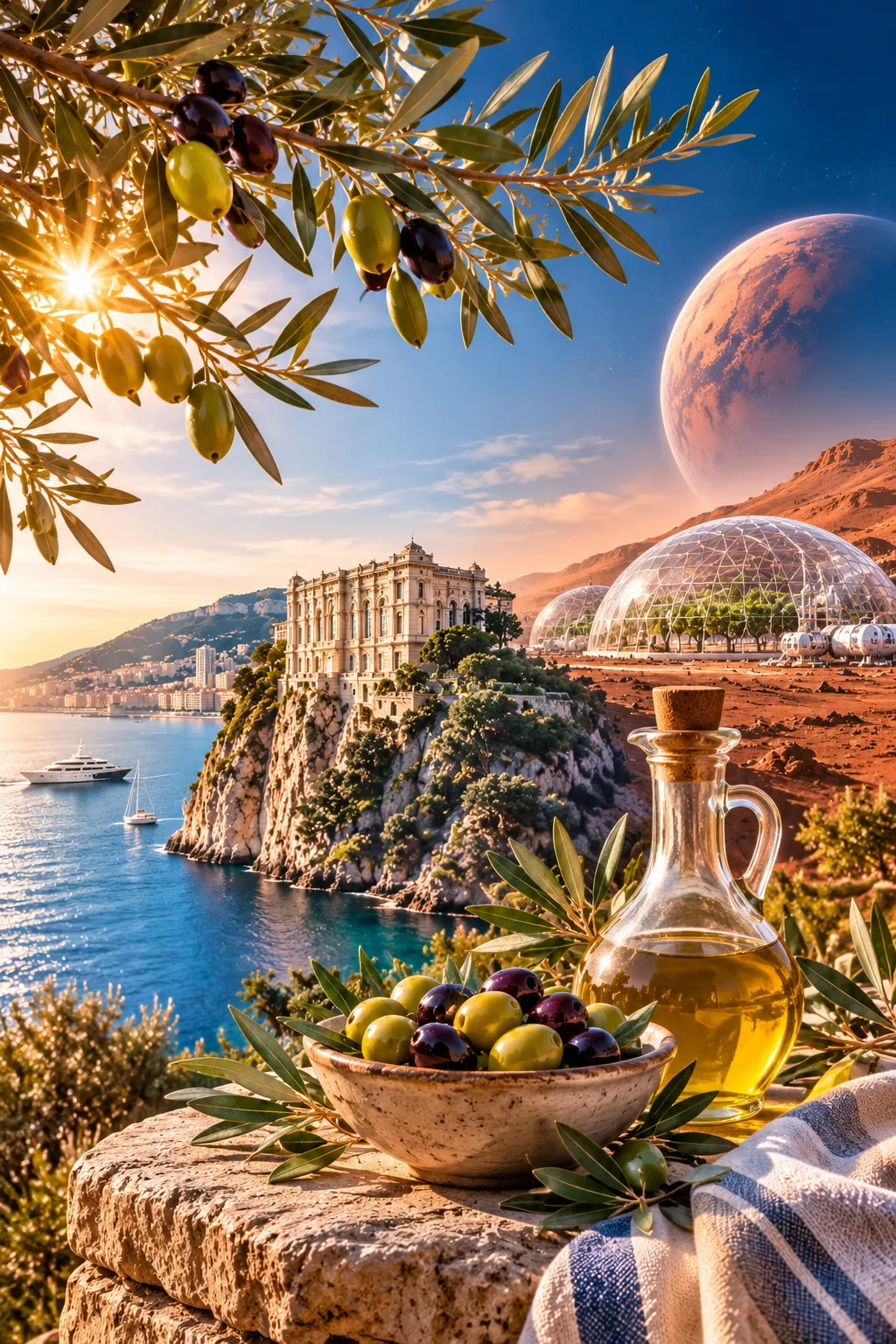

From Monaco to Mars · Could the Olive Tree Become a Future Food Pioneer?
One sea, one planet, and one remarkable tree that might have more to offer than we ever imagined.
What will the Mediterranean look like in 2050? Will its waters still be rich in marine life? Will future generations enjoy the same abundance of seafood, aromatic herbs, fresh vegetables and golden olive oil that have shaped Mediterranean cuisine for centuries? These questions are no longer just environmental concerns. They are becoming part of a much bigger conversation about the future of food, sustainability and the way we live.
This December, Monaco offers a fascinating opportunity to explore some of these questions through Mediterranean 2050, an immersive experience at the Oceanographic Museum of Monaco. It invites visitors to imagine the future of our sea, discover the challenges facing marine ecosystems and consider how today’s decisions might shape the Mediterranean of tomorrow.
For me, as a chef, this journey also raises another question: what will happen to the food traditions that make this region so special? And could some of the answers already be growing in our Mediterranean gardens?
A journey into the Mediterranean of tomorrow
The Oceanographic Museum has created an experience that goes beyond a traditional exhibition. Mediterranean 2050 takes visitors through a series of immersive spaces exploring the relationship between people and the sea, the history of marine conservation and the environmental challenges that lie ahead.
One of the most fascinating elements is Oceano Odyssey – Mission Pelagos, an audiovisual journey into a possible future of the Pelagos Sanctuary, a protected area of the Mediterranean dedicated to marine mammals. Through impressive projections and immersive storytelling, visitors can discover the underwater world and imagine what a healthier Mediterranean ecosystem could look like in the decades ahead.
The experience is both educational and thought-provoking. Rather than simply presenting environmental problems, it encourages visitors to reflect on the role we all play in protecting the sea. It is a reminder that the Mediterranean is not just a beautiful holiday destination. It is a living ecosystem that supports biodiversity, communities, local economies and an extraordinary culinary heritage.
As a chef, I cannot think about the future of the Mediterranean without thinking about food. Our cuisine has always been deeply connected to the landscape surrounding us. Fresh fish, seasonal vegetables, citrus fruits, aromatic herbs and olives are not simply ingredients on a menu. They represent centuries of knowledge, local traditions and a way of life built around the seasons.
However, rising temperatures, changing rainfall patterns and increasing pressure on natural resources are already challenging traditional food production. Some ingredients may become harder to grow, while farmers and producers will need to adapt their methods to increasingly unpredictable conditions.
Perhaps we should pay closer attention to the ingredients and plants that have already demonstrated an impressive ability to survive in this environment. One particularly interesting example is the humble olive tree.
The olive tree: a Mediterranean survivor with extraordinary potential
For thousands of years, the olive tree has been one of the defining symbols of Mediterranean life. It grows across landscapes where summers can be long, hot and dry, and its remarkable adaptations allow it to tolerate conditions that many other cultivated plants would struggle with. Its narrow, leathery leaves help reduce water loss, while its root system allows it to make use of available moisture in the soil.
But the olive tree is much more than a source of delicious fruit. It is an exceptionally versatile natural resource. Its olives can be cured, fermented, stuffed or transformed into olive oil, one of the most important ingredients in Mediterranean cooking. Olive leaves contain naturally occurring compounds that are attracting scientific interest, while olive wood is appreciated for its durability, beautiful grain and use in kitchenware and traditional crafts.
Even the parts left over from olive processing can find useful applications. Olive stones, pomace and other residues are being explored for bioenergy, agricultural materials and other forms of resource recovery. It is an excellent example of how a well-established agricultural crop can contribute to a more circular approach to food production.
Of course, drought tolerance does not mean that olive trees are indestructible. They still depend on suitable temperatures, water availability and healthy growing conditions. Extreme heat, prolonged drought and environmental degradation can affect their growth and productivity. Protecting traditional olive groves and supporting sustainable cultivation will therefore be essential for preserving this Mediterranean heritage.
From the Mediterranean to Mars: could olives have a future beyond Earth?
Now, let’s take the imagination a little further.
Imagine a future research greenhouse on Mars. Outside, the landscape is cold, dry and exposed to radiation. Inside a carefully controlled habitat, however, plants grow under artificial lighting, water is recycled and every available resource is used as efficiently as possible.
Could an olive tree become part of such a future ecosystem?
At present, this remains an intriguing idea rather than an established scientific possibility. Mars presents enormous challenges for agriculture, including extreme temperature variations, radiation, very low atmospheric pressure and the absence of naturally available liquid water on its surface. An olive tree could not simply be planted in Martian soil and left to grow. It would require a protected greenhouse with controlled pressure, temperature, light, water and suitable growing conditions.
Nevertheless, the olive tree offers an interesting starting point for thinking about resilient agriculture. Its adaptations to dry environments, its long history of cultivation and the many useful products it provides make it a fascinating plant to consider when imagining future food systems.
This is where the conversation becomes particularly exciting for us at Online-Chef. Through our MARS X project, we explore the idea of future human settlements and the systems that might one day support everyday life beyond Earth. Food production would be one of the most important challenges facing any such settlement. A future colony would need to grow nutritious food, recycle water, minimise waste and make the most of every available resource.
Perhaps one day, a small olive tree could grow inside a Martian greenhouse. And perhaps someone preparing the first Mediterranean-inspired meal on another planet will discover that a little olive oil makes everything taste better.
One future, two worlds
Whether we are talking about protecting the Mediterranean or imagining the first sustainable food systems on Mars, the underlying question is surprisingly similar: how can we produce food while respecting the environment and using resources wisely?
Mediterranean 2050 encourages us to look more carefully at the sea we already have. It reminds us that the future of our oceans depends on the choices we make today. At the same time, projects exploring life beyond Earth challenge us to think creatively about agriculture, technology and the limits of our current food systems.
For me, the future of food is not only about advanced technology or futuristic laboratories. It is also about understanding nature, respecting ingredients and preserving the knowledge that generations of farmers, fishermen and chefs have passed down to us.
The Mediterranean has given the world an extraordinary culinary heritage. Perhaps some of its most familiar ingredients will continue to inspire us in ways we cannot yet imagine.
And if humanity ever manages to create a thriving food garden on Mars, I would certainly hope there is room for at least one olive tree.
After all, even on another planet, a good meal deserves a little extra virgin olive oil.
Plan your visit: Mediterranean 2050 in Monaco
The exhibition takes place at the Musée océanographique de Monaco, spectacularly positioned above the Mediterranean Sea on the Rock of Monaco. It is an especially fitting location for an experience dedicated to the future of our oceans.
The Mediterranean 2050 experience is scheduled to remain available until 1 January 2030, making it possible to discover it throughout the winter season and beyond. For current opening hours, ticket availability and booking information, visit the official Oceanographic Museum website or purchase tickets online.
Online-Chef – Exploring the future of food, from the Mediterranean to Mars.
By Lizza · Online-Chef
