

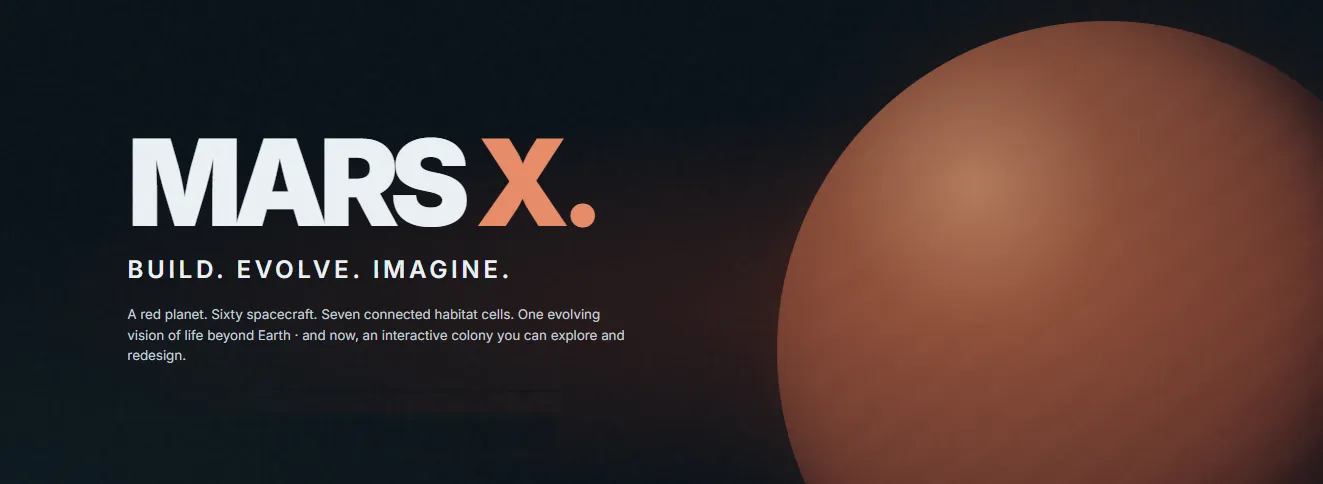

Sixty spacecraft, seven habitat cells and one very important question: where does everybody eat? Meet MARS X, a chef’s fun experiment in building a red-planet settlement, one dinner at a time.
MARS X · Year 25 · Sol-Inn Habitat · When a chef has too much free time, a planet gets involved. Every project has an origin story. This one began with a dream. In it, ships were arriving on Mars one by one, a settlement was growing cell by cell, and somewhere in the middle of it, one thought kept returning: there has to be a place to eat, and to feel human again.
So, with some free time and slightly too much imagination, we built MARS X: an independent, interactive Mars colony concept that you can explore in your browser. No installation, no account. Just you, a red planet and a rather ambitious construction schedule.
The Numbers (Because Chefs Always Ask for Numbers)
The concept is built around 60 spacecraft, seven connected habitat cells, 290 editable objects and 342 proposed residents. Yes, 342. Somebody has to cook for all of them. The colony grows in four proposed stages: a first foothold with industry and printing, then a greenhouse to grow food, then mining and heavy assembly, and finally technology, community and residential cells that complete the settlement.
As a chef, I noticed that food arrives in stage two. Which seems about right. You can survive a lot of things on Mars, but a long wait for lunch is not one of them.
A Workshop You Can Actually Play With
The online workshop lets you inspect ships and modules, move objects around, control arrivals, reveal interior spaces and export your own version of the colony as a JSON file. It works best on a computer, so open it at your desk rather than on the train.
It is a sandbox, not an engineering study. The layout, population and technical capacities are proposals, nothing more, and the project is not connected to SpaceX or any aerospace organisation. We just like building things and asking “what if?”
Not the First Restaurant. The First Dining Habitat.
This is where the kitchen comes in.
Sol-Inn Habitat is our name for the first dedicated place in the colony where people can slow down, sit together and feel at home. Think of it as part dining room, part decompression zone, part ritual hub: greenhouse-fed ingredients, warm light, longer tables and a calmer atmosphere.
Because food is never only fuel. Anybody who has worked a night shift knows that morale lives on the plate. Around it, we imagined a whole hospitality layer: a Greenhouse Kitchen Lab, crew suites, a lounge called Olympus, a closed-loop food hub and even a Mars Culinary Academy. All of these are concepts for now, and none of them are in the workshop’s 290 objects yet. Chefs are used to writing the menu before the kitchen exists.
Twenty-Five Years Later
The most fun part to write was Year 25: what Sol-Inn might look like after a quarter of a century of adaptation, maintenance and meals shared under the red sky.
Not a polished showroom, but a working food habitat. On the ground floor, robotic chef stations prepare fresh meals and a service called Sol-Away dispatches food for field crews. Above that, a 50-seat community restaurant. Higher still, a discovery level for chef and botanical research, and on top an observation café with a robot barista and a view of Mars.
Next door sits a separate emergency food reserve, because every kitchen manager knows the golden rule: always have a plan B in the dry store. We are, of course, very aware that this is a speculative vision and not a verified design. But it is a good vision.
Coming Soon: The First Dinner
The next transmission is already in development: an interactive story called The First Dinner. 342 people. A fragile food system. One kitchen. What could possibly go wrong?
– Everything. Everything could go wrong. That is exactly why it will be fun.
Chef’s Verdict
Would I serve dinner on Mars tomorrow? Not without a risk assessment, a food safety plan and a very long conversation with the supplier about delivery times. But would I like to see how people design a place where a colony gathers around a table? Absolutely.
Because wherever humanity goes, one question will follow us: “What’s for dinner?”
Stay curious. Keep cooking. And remind the robot chef that a little more seasoning is not a system error.
Z. · Online-Chef
MARS X is an independent speculative and creative concept. The layout, population, infrastructure and technical capacities are proposals, not validated engineering or life-support performance. It is not affiliated with, sponsored or endorsed by SpaceX or any aerospace organisation.