

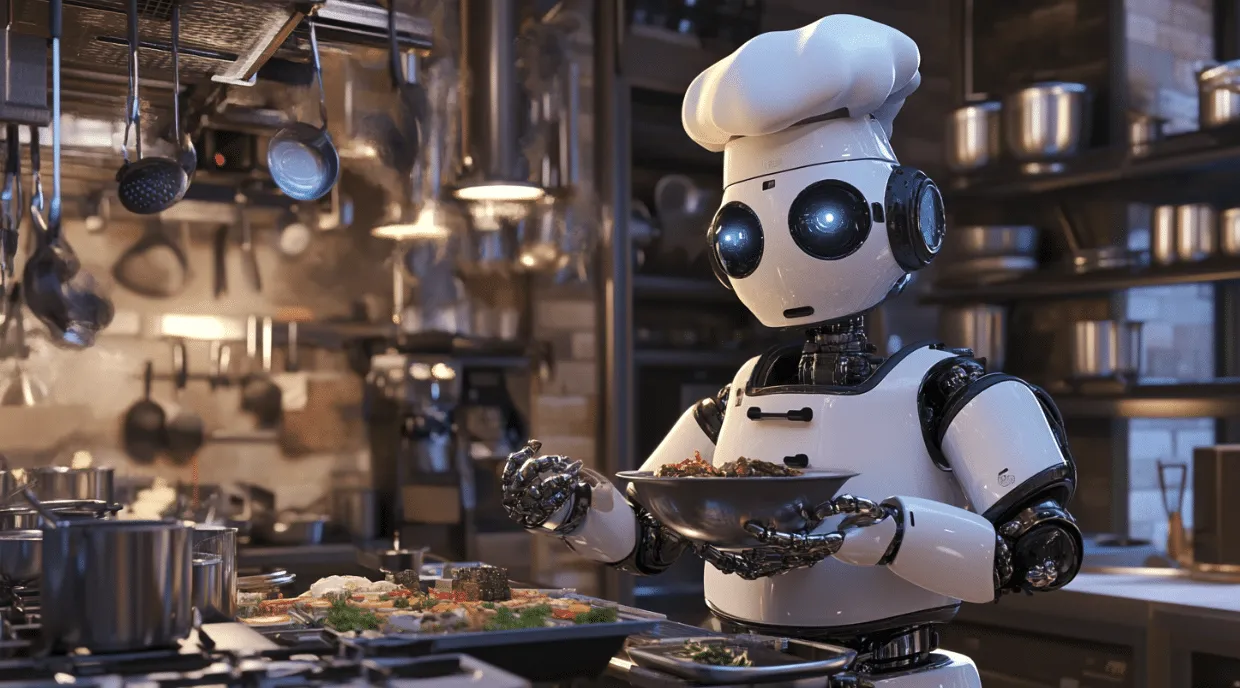
Robot arms are filling meal trays, a Tokyo pilot restaurant is testing a kitchen with no cooks, and food factories are quietly running out of people. A chef’s look at where automation in food production really stands right now.
Automation in food · Less science fiction, more conveyor belt.
For years, “robots in the kitchen” meant a viral video of a burger flipper, a shiny prototype at a trade show and, a few years later, a quiet press release about the company closing. The idea always sounded wonderful. The economics usually did not. This autumn, however, something has shifted, and it has happened mostly where nobody takes photographs: on the production lines of companies that make ready meals, frozen dishes and packaged food.
The boring revolution on the meal line
The most interesting story is also the least glamorous. Chef Robotics, a San Francisco startup, says its AI-guided robot arms have now handled more than 120 million servings in production. A “serving” here is one portion placed into a tray, so it counts a meal component rather than a finished meal. That is a fair detail to keep in mind, but the scale is still remarkable. According to the company’s own case study, a New York maker of Indian-inspired meals called Café Spice used to cap out at around twelve trays a minute, with eight to ten people per line pushing bowls down a table. After adding robots and a conveyor, its lines now average about thirty trays a minute, and the company reports a 67 percent reduction in excess food in the trays. At Amy’s Kitchen, a producer of organic frozen meals, the assembly line previously needed about twelve people per shift, and a 17 percent gain in labour productivity was reported, along with fewer repetitive-motion injuries.
What makes this different from the failed attempts is flexibility. Food manufacturers rarely make one product. They run many recipes, each with its own mix of ingredients, textures and portion sizes, and traditional automation hates change. The newer “physical AI” systems are designed to adapt to different ingredients and switch recipes quickly. It is also telling how they are sold: the robots are rented as a service, so a factory does not have to buy them outright. Reports also describe the company’s next move into smaller kitchens, including a large airline caterer.
It is worth remembering the graveyard. Several earlier food-robot startups collapsed, including the salad robot maker Chowbotics, which was shut down after being acquired, and Zume, which burned through hundreds of millions of dollars. The survivors seem to have learned the same lesson any chef learns early: do the unglamorous job reliably first.
Hygienic design and the machines nobody sees
Away from the tray line, the equipment makers are working on the unexciting problem of keeping robots clean. At Cibus Tec in Parma, held from 27 to 30 October, Comau presented a new hygienic range of robots that use food-grade lubricants to reduce contamination risk without needing protective covers. Earlier in the year, FANUC introduced pre-engineered collaborative robot packages for food and beverage plants at Automate 2026 in Chicago. None of this makes a good video, but a robot that can be washed down properly is a robot a food safety manager will actually allow into the room.
Tokyo: a kitchen with nobody in it
At the other extreme sits a pilot in Tokyo. A restaurant called Kitchen MAGIC ROAD, set in a service area beside an expressway, was planned to open on 28 October. According to reports, its I-Robo 2 kitchen robot mixes ingredients, heats dishes and even washes the pots afterwards. The purpose is to test whether a staffless kitchen model could later be placed along Japan’s highways, where cooks are hard to find. It is an experiment and nothing more at this stage, so let us wait for real results before declaring anything.
A similar idea has been running in North America. Appetronix, a Canadian company, builds fully autonomous stand-alone kitchens rather than automating existing ones. Its first, a pizza kitchen for the chain Donatos at Columbus airport, opened in June 2025 and operates around the clock.
The real driver is a shortage, not a fantasy
Why now? Mostly because there are not enough people. Trade analysis describes the food plant labour shortage as structural rather than a temporary dip, with an ageing workforce and too few new skilled applicants. The sharpest observation I read was that automation is largely backfilling shifts nobody applied for, rather than replacing people who are already there. That does not mean no jobs change. Other reports point to a shift towards roles in oversight, maintenance and data, and a skills gap that plants struggle to close. But the framing matters: in many plants the question is not “who do we let go?” but “who will run the line on Saturday?”
A few honest warnings
Before we all order a robot, some caution. Many plants run on equipment installed decades ago, and connecting it to sensors, robots and AI is harder than the brochures suggest. Market forecasts vary wildly depending on who defines “food robotics”, so I would treat the billion-dollar headlines with suspicion. And a good share of what is published on this topic comes from companies that sell the technology. The cleanest numbers above are company-reported case studies, and they should be read as exactly that.
Chef’s verdict
What strikes me is how neatly this fits a line we wrote earlier this year: AI is excellent for control, but it is not a cook. A robot that places 300 grams of rice into a tray, records the weight of every portion and does not get a strained wrist at the end of a shift is doing exactly the kind of work chefs have always been happy to hand over. Measurable, repetitive, hard to staff. Nobody is asking the robot to season the sauce.
The taste, the judgement and the decision about what goes on the plate remain human work, at least for now. And if one day a robot does start commenting on your seasoning, please check whether it has been connected to the right account.
Stay curious. Respect the line cook. And always check the portion weight.
Jan · Online-Chef
Editorial note: Based on reporting and industry sources from 2026, including PYMNTS (20 October 2026) summarising Chef Robotics, TechCrunch, AgFunderNews and Automation World; Comau’s Cibus Tec 2026 announcement; ProKitchen Expo’s weekly review (27 October 2026) on the Tokyo pilot; and Food Industry Executive on labour shortages. Performance figures for Café Spice and Amy’s Kitchen are company-reported or as reported by the cited trade media. The Tokyo restaurant was scheduled to open on 28 October 2026 at the time of reporting; we have not confirmed its results. Commentary is Online-Chef’s independent culinary opinion.