


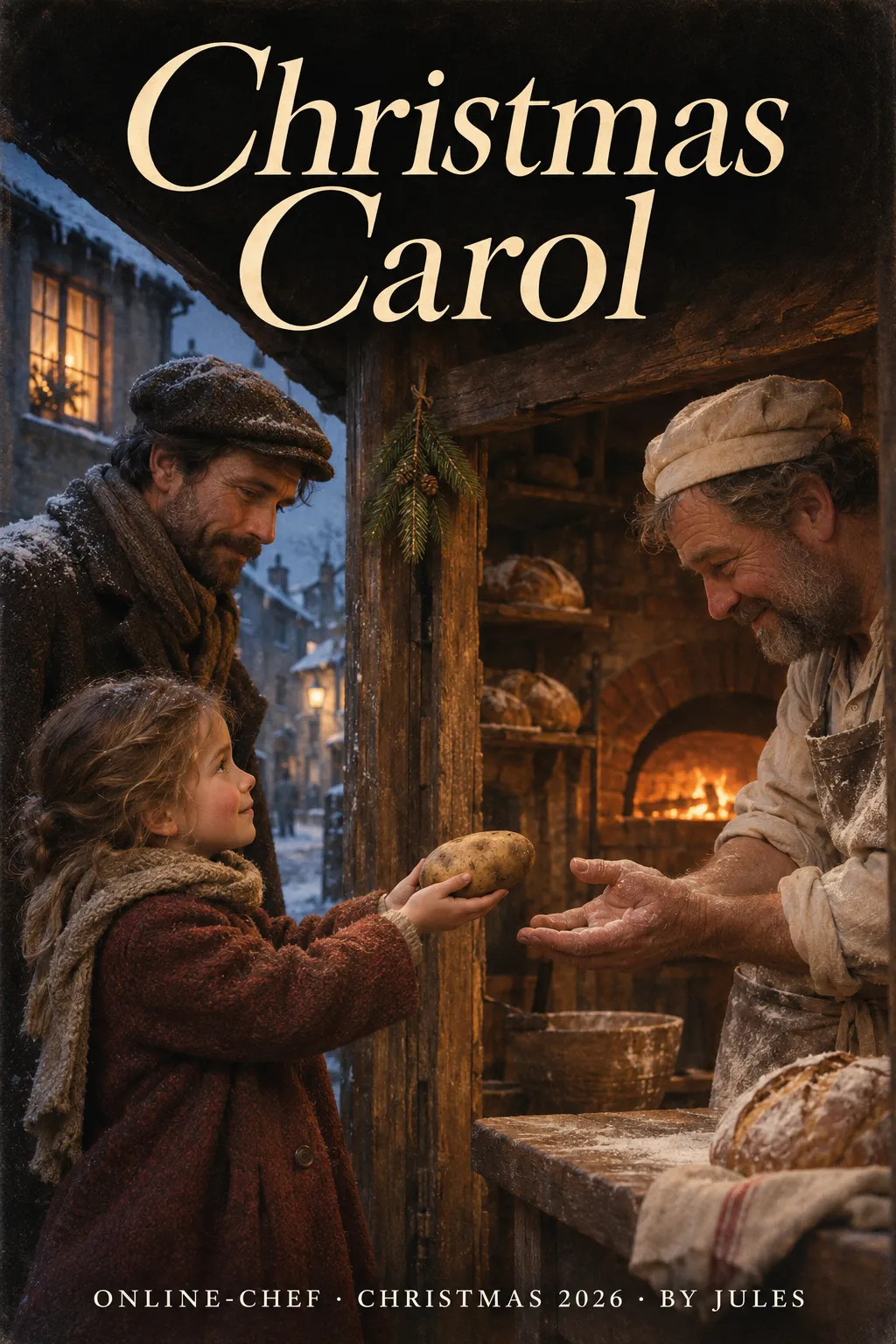

On Christmas Eve, the people of Bellune took their dinners to the dead baker. At least, that was how his son saw it when he came downstairs at half past two and found a goose on the doorstep. The bird lay breast-up in a handsome blue roasting tin, with an onion under each wing and a luggage label tied to one leg. Madame Rossi, fourth floor. Please knock hard.
Thomas was still in his socks. He stepped over the goose to look up and down the street. At the corner, a small woman in a green coat was making excellent speed for someone who had evidently just abandoned nine pounds of poultry. “Madame!” he called. She raised one hand, whether in greeting or to indicate that the matter was settled, and disappeared behind the florist’s van.
He carried the goose inside. His father’s oven was warm. Thomas himself had lit it that morning to bake the last six loaves, because there was flour left in the bin and he could think of nothing worse than selling a bakery with half a sack of flour in it. On the workbench lay the papers for the sale, his ticket for the evening train and a heel of bread with a single bite taken out of it. He had been meaning to finish his lunch for three hours.
By three o’clock he had acquired a dish of potatoes, two trays of stuffed onions and a boy called Luc, who arrived holding a pear tart in both hands. The tart leaned sharply to the left. So did Luc, in the opposite direction, to compensate. “My grandfather says yours is the only oven in town that cooks the bottom properly,” he told Thomas.
“Does your grandfather know my father died in September?”
“Yes. He went to the funeral. You had egg sandwiches afterwards and my sister was sick in a handbag.” Luc considered this a moment. “It was our own handbag,” he added, in fairness.
Thomas took the tart. He had spent the autumn finding things out about his father that everybody else appeared to know already. On Tuesdays he cut the postman’s hair. He owed the florist eleven euros at cards. And apparently, on Christmas Eve, he cooked half the street’s dinner. This last discovery irritated Thomas more than the others. As a boy he had waited every Christmas for his father to come upstairs, carve the goose and pull the paper crown out of his cracker. Every year his mother had eventually handed Thomas the knife.
“Where did he write down the times?” he asked. Luc pointed to the tall cupboard beside the oven. On the inside of its door, in pencil, were thirty years of Christmas dinners.
Rossi, goose, two fifteen.
Martin, potatoes, top shelf.
Little Alma, apples, no nuts.
Near the bottom, beneath a shelf that had sagged with age, Thomas found an entry in his own handwriting. Thomas, one potato, whenever.
He remembered that potato. He must have been seven. He had washed it with soap, wrapped it in enough foil to insulate a house and presented it to his father during the busiest hour of the year. At supper it had appeared on a saucer, split neatly down the middle, with butter in the cut. He had forgotten how pleased he was to have cooked something for everybody. They had each been allowed a teaspoonful.
Thomas put the goose in first. The potatoes could have the shelf beneath it later. He slid Luc’s tart onto the hot stone floor of the oven and set a timer. “Tell your grandfather four o’clock,” he said. “And next year he can bring that thing on a tray.”
It was only when Luc had gone that he heard himself say next year.
At six, the bakery filled with people collecting their dishes. Money appeared on the counter and Thomas pushed it back. Somebody poured him a glass of wine. The goose came out a magnificent chestnut brown, and Madame Rossi arrived in person to supervise its removal. She was smaller without her coat. Thomas asked whether she could manage the stairs with it.
“Your father always carried it,” she said. Then, perhaps seeing something in his face, she added, “He used to swear on the third floor. Every year in exactly the same place.”
“I know,” said Thomas. “We lived on the second. We could hear him going past.”
Madame Rossi put down her oven gloves. “Oh,” she said. It was a small word, but she sat with it a while. Then she fetched the two young men from the florist’s van and sent them upstairs with her goose.
By half past six everything had gone except a shallow brown dish at the back of the oven. Thomas drew it forward. Inside lay a single baked potato, its jacket lightly salted. He looked round for Luc, but the boy had gone home with his grandfather. The shop door was locked. Thomas was quite certain he had peeled every potato in the building that morning, and equally certain that if his father had been granted one brief visit from the other world, he would have spent most of it complaining about where Thomas kept the bread knife.
He carried the dish upstairs. His sister Elise had laid the table for two. There was mustard, a small joint of ham and the good linen napkins, still creased from the drawer. She looked at the potato and smiled. “I put it in when you were out front. Do you remember that awful soapy one? Papa ate the skin because neither of us would.”
Thomas sat down. The church clock struck seven. He could still make his train if he left before pudding. Instead, he cut the potato in half and gave his sister the larger piece. For a little while they ate with their elbows on the table, talking about their father as he had actually been. It was a relief to remember that a man could lend his oven to an entire street and still owe you several Christmas dinners.
Then came a knock from below. Thomas laid down his fork. Elise caught his wrist. A second knock followed, and Madame Rossi’s voice rose through the floorboards, perfectly audible to two children who had grown up above a shop.
“Stay where you are! I’ve left you a leg. And the good bit of stuffing. Eat it while it’s hot.”
They heard her start back up the stairs. On the third floor she swore.
The following September, the new owners moved into the bakery. Thomas showed them the flue, the sticking till drawer and the marks on the cupboard door. What they chose to do at Christmas was their own affair. He did, however, give them Madame Rossi’s number and advise them to invest in a decent pair of oven gloves.
On Christmas Eve he came back with his daughter. She was five and carrying a potato in both hands. The new baker gravely asked what time she would like it done. She glanced up at Thomas, suddenly shy, so he lifted her high enough to reach the cupboard door. There was a clean patch of wood just below his own name. In enormous, uncertain letters she wrote Alice.
“And when shall we come and get it?” her father asked.
She thought about her aunt upstairs, laying the table. “When everybody’s sitting down,” she said.
The End
Jules · Online-Chef · Christmas 2026