

Why modern kitchens use AI for control — not creativity
In 2026, artificial intelligence is being discussed in almost every part of the food industry. Restaurants are investing in smart systems that track stock, monitor temperatures, predict consumption, support ordering, and help managers plan more efficiently.
AI is becoming a normal part of back-of-house technology, just like POS systems, digital thermometers, and online reservation tools became normal before it. But there is one thing almost everyone can agree on — from tech companies to experienced chefs: AI is excellent for control, but AI is not a cook.
AI can calculate. A chef can cook.
A professional kitchen is a place where system, speed, instinct, pressure, and real-time decision-making all meet at once. AI can process data, but it cannot read a service. It can calculate, but it cannot taste. It can monitor, but it cannot lead a team. It can suggest, but it cannot feel when something is just right.
That is why AI is most useful in the parts of the kitchen that are clearly defined, repetitive, measurable, and based on data: inventory, stock control, temperature records, food cost, waste, ordering, labeling, and planning. This is where AI can genuinely help a professional kitchen.
Personal experience: AI has saved me hours of life
As a chef, I can say this honestly: AI has saved me hours of life on tasks that used to destroy me. I remember spending the last day of the year doing a full inventory, then spending another week calculating recipes, portions, prices, food cost, and stock differences.
Today, the same type of work can be done in one morning. For these jobs, AI is incredibly useful. Recipe calculations, portion conversions, food cost, selling price logic, and stock comparison can all become faster, cleaner, and more accurate when the system is properly built.
And I can already see the next big step coming: smart labeling. Imagine a kitchen where, at the end of every shift, the system already knows what is in the fridge. You only add the real waste from service, and AI connects sales, consumption, leftovers, expiry dates, stock levels, and future orders.
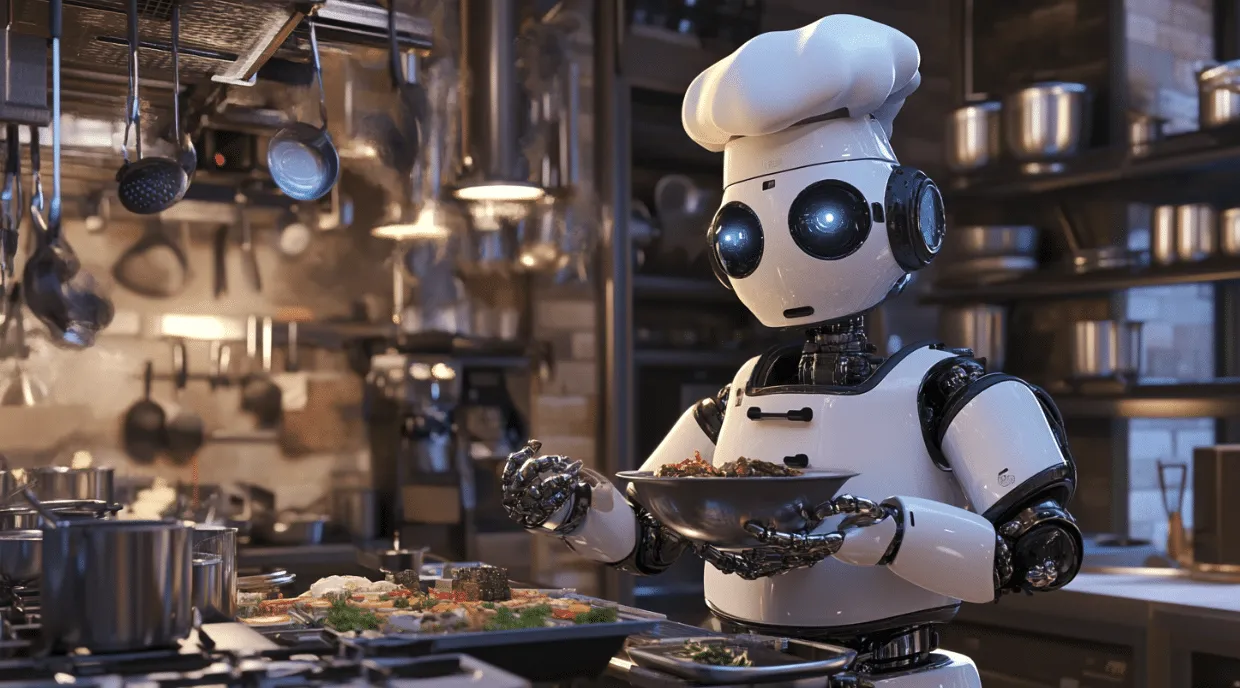
That is the real future of AI in the kitchen. Not a robot pretending to be a chef, but a system that knows what you have, what you used, what you lost, and what you will need tomorrow.
Morning mise en place: the part AI will never understand
Then there is the morning mise en place. This is the part AI will never truly understand.
It is 9:30 in the morning and half the work is already done. Not because someone analysed it. Not because a dashboard suggested it. But because the chef simply started.
You light the burners, warm the pans, and take out the pots you know you will need. You look at the size of the pot and already know how many ingredients to take from the fridge. You bring everything out at once. You start cutting. You begin the stocks, the sauces, the bases, the vegetables, and the preparations.
Not two things. Ten things at the same time.
And when you stop, turn around, and look behind you, the mise en place is there like a small factory ready for the day. AI may know what is in the fridge, but it does not know how a kitchen wakes up. That part is human.
Where AI really helps
AI is especially useful in professional kitchens when the task is based on measurable information. Inventory is one of the strongest examples. Smart systems can scan stock, compare stock levels with sales, predict what will be needed, and help reduce ordering mistakes. A task that once took hours can become much faster when the data is connected properly.
Food safety control is another clear area. Smart sensors can monitor fridge temperatures, detect open doors, track temperature changes, and keep automatic records for HACCP follow-up. This does not replace proper hygiene discipline, but it can support it. It reduces forgotten checks, protects the cold chain, and gives the chef or manager better visibility.
Food cost and planning may be one of the most useful areas of all. AI can connect recipes, ingredient prices, seasonality, sales data, and waste. It can show which dishes are profitable, which ones are weak, where money is being lost, and how a change in ingredient price affects the final margin. It does not tell the chef what to cook. It shows the financial impact of the chef’s decisions.
Where AI ends
There is a clear line AI cannot cross. AI cannot taste, feel texture, recognise the “just right” moment, improvise like a chef during service, read the team, read the guest, or create with real memory, emotion, and experience.
Cooking is not only a sequence of steps. It is a combination of technique, instinct, timing, pressure, correction, and judgment. This is where the human factor remains irreplaceable.
Future kitchen: when robots do the basics, chefs can focus on craft
One day, we may see a real future kitchen where robots and smart systems can handle the heavy basic work. A system that can take ingredients from storage, sort them, cut basic vegetables, prepare stocks, refill stations, label products, and update inventory automatically would genuinely help chefs.
That would be a true future kitchen. And honestly, that kind of technology would be useful. But cooking itself will take much longer to replace, because cooking is not only logistics. Cooking is decision.
Conclusion
AI has a clear place in the modern professional kitchen. It belongs in inventory, stock control, safety records, food cost, prediction, ordering, and planning.
It also has clear limits. Taste, intuition, creativity, team rhythm, pressure, timing, and final decision-making still belong to the chef.
The modern kitchen needs both: smart systems for control and real chefs for the craft. And maybe that is the real future of professional kitchens — not replacing chefs, but finally giving them better tools.