

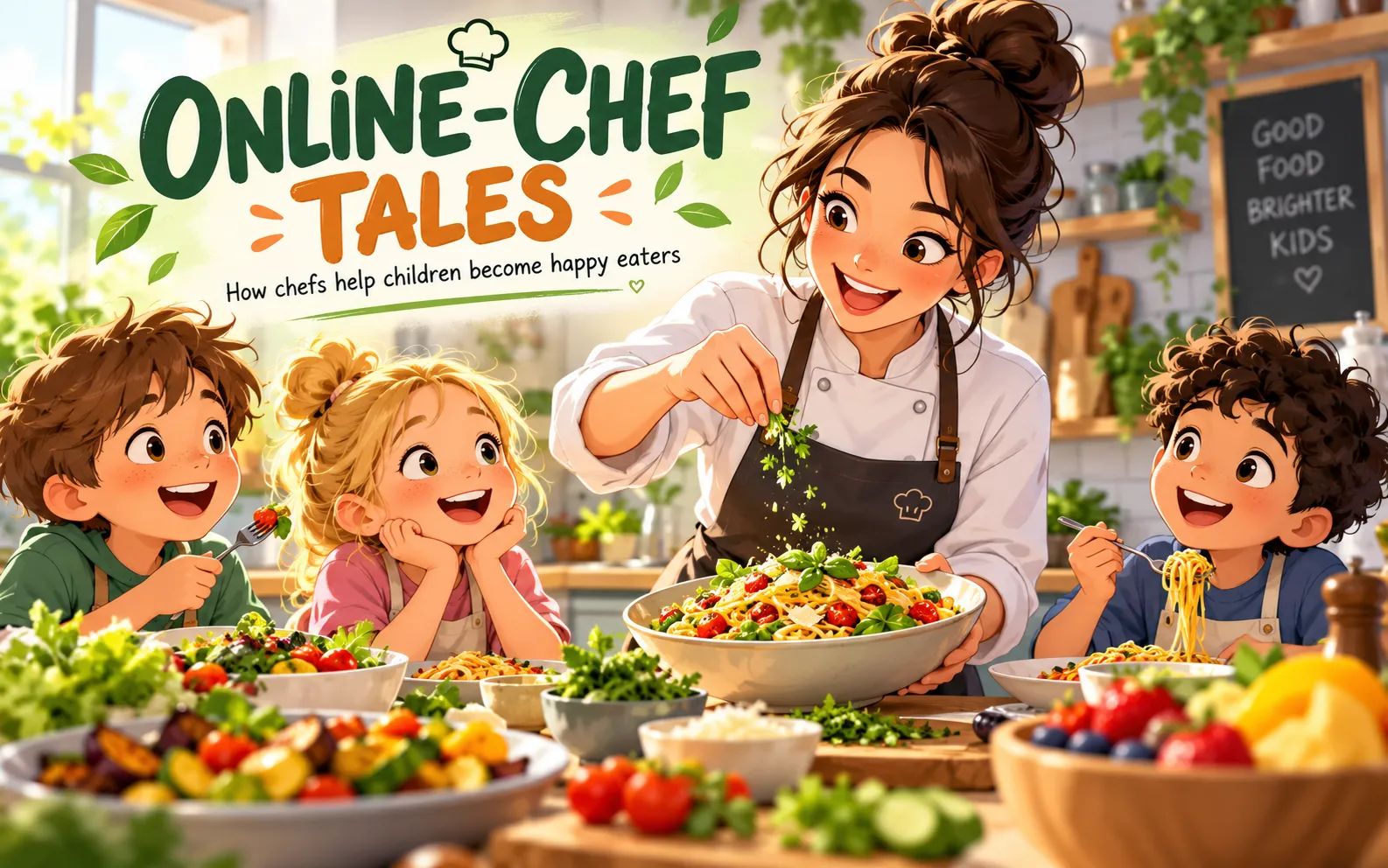

Wondering how to get kids to eat vegetables? Even world-class chefs struggle with that question · and their experiences might surprise you.
ONLINE-CHEF TALES · By Chef Lizza · October 31, 2026
Why Even Top Chefs Can’t Convince Their Kids to Eat Vegetables ?
Imagine spending twenty years perfecting your culinary skills. You’ve mastered sauces, conquered soufflés, learned to balance flavours with surgical precision, and survived restaurant kitchens where a slightly overcooked scallop can ruin somebody’s evening. Then you go home, serve your beautifully roasted vegetables, and your five-year-old announces, “I don’t like green.”
Congratulations, Chef. You’ve just met the toughest food critic of your career. And unlike restaurant critics, this one doesn’t even bother to taste the food.
An article published in The Guardian on October 31, 2026, brought together some remarkable culinary personalities, including Tom Kerridge, Meera Sodha, Helen Goh, Jackson Boxer and others, to discuss a surprisingly universal problem: feeding their own children. And guess what? Even professional chefs struggle. Their children reject vegetables, change their favourite foods overnight, develop mysterious texture preferences, and occasionally behave as if a mushroom were an unidentified object from outer space.
One day, pasta is the greatest invention in human history. The next day, apparently, pasta has committed an unforgivable crime. For parents, this can be exhausting. For professional chefs, there’s an additional complication: their professional pride is on the line. Imagine impressing hundreds of restaurant guests but failing to convince your own child to eat three peas. Somewhere in the universe, a chef is probably shouting at a broccoli floret.
Stop Fighting the Broccoli
Here’s something I love about these chefs’ experiences: most have learned that forcing children to eat rarely creates happy memories. The more you push, the more determined some children become to resist. Suddenly, instead of a family dinner, you’re negotiating an international peace treaty involving two carrots and a spoonful of spinach.
My advice? Stop making vegetables the enemy. Serve them naturally, cook them well, give them flavour, eat them yourself, and, most importantly, don’t turn every rejected bite into a national emergency. Children often need repeated opportunities to become comfortable with unfamiliar foods. That doesn’t mean serving the same sad, boiled broccoli every Tuesday and hoping for a miracle.
Try roasting it until the edges become golden and crispy. Add a little olive oil, perhaps some grated Parmesan, or serve it alongside something your child already loves. The vegetable hasn’t changed its identity, but its chances of being accepted may have improved dramatically.
And sometimes the problem isn’t even the vegetable itself. It’s the texture.
Helen Goh shares an interesting example involving roast chicken. One of her children dislikes the fatty texture of the skin, while another happily enjoys the leg, skin included. Same chicken, same family, completely different opinions. Adults often interpret a child’s refusal as hatred of an ingredient, but children may actually be reacting to texture, temperature, smell, appearance, or the way food feels in their mouth.
A carrot isn’t necessarily just a carrot. It can be crunchy, soft, grated, roasted, glazed or mashed. Before declaring an ingredient permanently banned from the family menu, try changing its preparation. After all, we chefs spend our careers exploring textures. Why shouldn’t children have preferences too?
Give Them a Job, Chef!
Tom Kerridge describes how involving his son in food preparation can make meals more appealing, and I couldn’t agree more. Children love being part of something important. Let them assemble their own pizza, choose vegetables for skewers, mix a dressing, or sprinkle herbs over pasta. Suddenly, they’re not simply being told to eat dinner. They’re participating in its creation.
There’s something wonderfully powerful about a child proudly announcing, “I made this!” Even if their contribution consisted mainly of putting seven cherry tomatoes in the wrong bowl.
A small warning, though: cooking with children takes patience. There will be flour on the floor, sauce on the walls and at least one mysterious sticky object attached to the refrigerator. Your kitchen may resemble a crime scene, but the memories are worth it. And who knows? Your little assistant might even taste that suspicious-looking courgette.
One of my favourite ideas comes from Meera Sodha, whose family enjoys meals where everyone can assemble their own combinations. Think falafel with different toppings, colourful bowls, wraps or rice dishes with ingredients served separately. This is clever for two reasons: children feel they have some control, and unfamiliar ingredients become less intimidating when they’re sitting beside familiar favourites.
Imagine a table filled with warm flatbreads, crunchy cucumber, hummus, grated carrots, falafel, tomatoes and several colourful sauces. Nobody needs to announce, “Tonight, you MUST eat cucumber.” Instead, children explore. Perhaps they choose only bread and hummus today. Next week, they add a little carrot. Eventually, a tomato sneaks into the party. Progress! And the adults get to enjoy dinner without delivering a forty-minute lecture about vitamins.
The Great Vegetable Disguise
Now we arrive at one of the most controversial operations in family cooking: Operation Hidden Broccoli.
We’ve all heard the strategy. Blend carrots into tomato sauce, sneak spinach into smoothies, disguise courgettes in chocolate cake. Some chefs use blended vegetables to add nourishment to familiar dishes, and there’s nothing wrong with incorporating vegetables into sauces, soups or stews. But chef and author Marie Mitchell makes an important point: if children never know what they’re eating, they may never discover that they actually enjoy it.
That’s worth remembering. A delicious tomato sauce containing carrots is still a delicious sauce. But perhaps we should also introduce carrots openly, prepared in ways that children might appreciate. Because the goal isn’t to trick a child into swallowing broccoli forever. The goal is to help them recognise food, explore it and eventually make their own choices.
Besides, children are smarter than we sometimes think. One day they’ll discover your secret spinach operation, and then you’ll have a trust issue with a six-year-old detective. Good luck explaining that one.
Don’t Turn Dessert Into a Royal Ceremony
Here’s another lesson worth stealing from professional kitchens: be careful about treating sugar as the ultimate reward. Think about the message we sometimes send: “Eat your horrible vegetables, and then you can have something wonderful!”
Well, that’s excellent marketing for chocolate cake. Not so wonderful for broccoli.
Of course, desserts belong in life. I would be the last chef on Earth to declare war on a good chocolate mousse. But making sweets a trophy for finishing dinner can create an unnecessary hierarchy between foods. Children begin to associate vegetables with obligation and dessert with victory.
A better approach is to make the entire eating experience enjoyable without turning each meal into a reward-and-punishment system. A fresh strawberry can be delicious. So can roasted pumpkin. And yes, so can chocolate cake. They’re different foods serving different purposes. They don’t need to compete for the title of Supreme Ruler of the Dinner Table.
The Most Important Ingredient Isn’t on the Plate
Many chefs in the article return to the same beautiful idea: family meals are about much more than nutrition. They’re about connection. A big platter in the middle of the table, people sharing bread, someone asking for more sauce, a child telling a ridiculous story, parents laughing because the dog has stolen something from the kitchen. This is food culture, and it matters.
Children learn by watching the people around them. When adults enjoy different foods naturally, without drama, children get to experience variety as part of ordinary life. They see that meals are something to look forward to, not examinations they must pass.
Of course, not every family has the time or energy for a perfect dinner together. And let’s be realistic: some evenings, simply getting everyone fed feels like winning a gold medal. That’s fine too. A bowl of pasta shared with love can be far more meaningful than an elaborate three-course meal served with tension.
What I find particularly reassuring is how honest these professional cooks are about their own experiences. They aren’t presenting perfect children eating perfectly balanced meals from perfectly arranged plates. They’re describing real family life, with changing tastes, rejected dinners, occasional frustrations and small victories.
And perhaps that’s the biggest lesson here. Cooking for children isn’t a competition. Nobody wins a Michelin star for convincing a toddler to finish their peas. The best result isn’t an empty plate achieved through pressure, but a child who gradually becomes comfortable discovering new foods.
an note..
After reading these chefs’ stories, I came away with one comforting conclusion: even the best cooks in the world cannot control a child’s appetite. And perhaps they shouldn’t try.
We can prepare beautiful food, offer variety, teach cooking skills and introduce flavours. We can make meals colourful, relaxed and delicious. But curiosity cannot be forced. It grows through experience.
So the next time your child rejects something you’ve lovingly prepared, remember that you’re in very distinguished company. Some of the world’s finest chefs are having exactly the same argument at home. Don’t panic, don’t take it personally, and please don’t threaten the broccoli.
Try again another day, perhaps with a little butter, a different texture and a lot less pressure. Because our mission isn’t to raise children who obediently clean their plates. It’s to raise people who enjoy discovering what’s on them.
And if they eventually grow up loving vegetables? Wonderful. If they also learn to cook dinner for you? Now THAT is what I call a successful culinary education.
Stay curious. Keep cooking. And remember — even the smallest food critics deserve a little patience.
Chef Lizza 👩🍳 – online-chef.com